
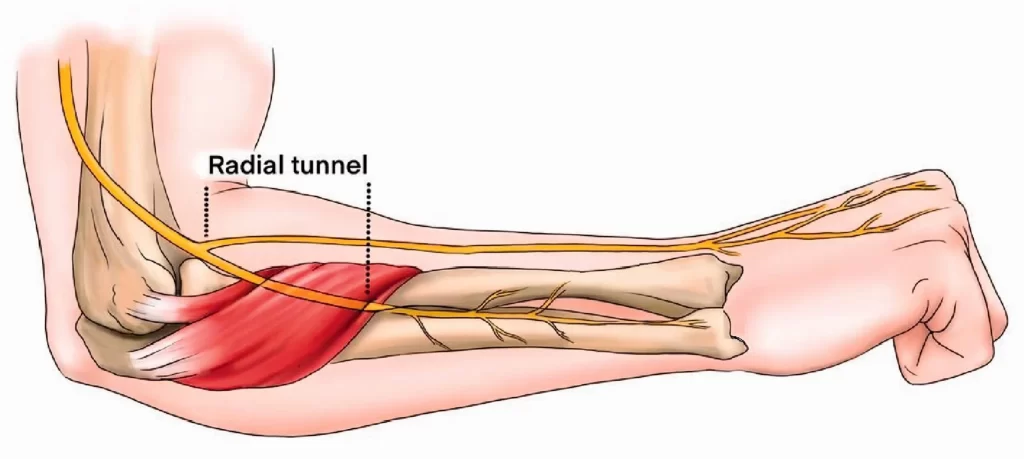
🧠 What Is Radial Tunnel Syndrome?
Radial Tunnel Syndrome (RTS) is a nerve entrapment condition where the posterior interosseous nerve—a motor branch of the radial nerve—gets compressed in a narrow passage near the elbow known as the radial tunnel.
Unlike carpal tunnel syndrome (which affects the wrist) or tennis elbow (which affects tendons), RTS involves nerve compression that produces deep, aching pain in the forearm.
🕵️♂️ The Underdiagnosed Reality
Most RTS cases are misdiagnosed as tennis elbow because the pain appears in a similar location—around the lateral elbow.
But here’s the kicker:
- RTS pain is nerve-based: deep, achy, burning.
- Tennis elbow is tendon-based: sharp, localized, and worsens with gripping or lifting.
Most doctors don’t suspect RTS unless they’re specifically trained in nerve entrapment conditions. It’s a clinical diagnosis, meaning it can’t be confirmed by imaging or standard nerve tests in most cases.
📋 Radial Tunnel Syndrome vs Tennis Elbow: What’s the Difference?
| Feature | Radial Tunnel Syndrome (RTS) | Tennis Elbow (Lateral Epicondylitis) |
|---|---|---|
| Cause | Compression of the radial (posterior interosseous) nerve | Degeneration of the extensor tendon at the elbow |
| Pain Location | 4–5 cm below lateral epicondyle | Directly on lateral epicondyle |
| Pain Type | Deep, aching, sometimes burning | Sharp, localized |
| Pain Triggered By | Resisted supination, elbow extension | Gripping, wrist extension, lifting |
| Numbness or Tingling? | Rare | Rare |
| Weakness | May affect wrist/finger extension in severe cases | Rare |
| Middle Finger Test (Maudsley) | Usually negative | Positive |
| Imaging/EMG Findings | Often normal | Often normal |
| Diagnosis | Clinical (based on symptoms and exam) | Clinical |
🔍 So… What About the Middle Finger Test?
The Middle Finger Test (Maudsley Test) is commonly positive in tennis elbow, not RTS.
- The test resists extension of the middle finger while the arm is extended.
- It stresses the extensor digitorum tendon, which originates from the lateral epicondyle.
👉 While some clinicians use this test to try to provoke RTS pain, a positive result points more strongly to lateral epicondylitis, not radial tunnel syndrome.
✅ Better RTS Diagnostic Clues:
- Pain 4–5 cm below the lateral epicondyle
- Pain worsens with resisted supination
- No increase in pain with gripping
💥 Symptoms of Radial Tunnel Syndrome
- Dull, deep ache in the outer forearm
- Pain worsens with elbow extension or repetitive use
- Tenderness over radial tunnel (not the epicondyle)
- Occasional weakness in hand or wrist
- No tingling or numbness (unlike carpal tunnel)
🔁 Common Causes and Risk Factors
- Repetitive forearm rotation (e.g., screwdriver use)
- Jobs involving pronation/supination or lifting with palm down
- Poor workstation ergonomics
- Direct trauma or hypertrophy of the supinator muscle
❌ Why Radial Tunnel Syndrome Gets Missed
- Looks like tennis elbow on exam
- Doesn’t show up on X-ray, MRI, or often even EMG
- Many clinicians aren’t trained to test for it
- Symptoms overlap with cervical spine or shoulder conditions
🧪 Diagnostic Tip: Supination Against Resistance
To test for RTS:
- Have the patient attempt to supinate their forearm (rotate palm up) against resistance with the elbow extended.
- If this provokes deep forearm pain, it may suggest RTS due to compression at the supinator muscle.
🛠️ Treatment That Actually Works
🧘 1. Activity Modification
Reduce repetitive tasks involving forearm rotation. Switch to ergonomic tools and avoid prolonged gripping or palm-down lifting.
🧠 2. Targeted Hand Therapy
- Nerve gliding exercises
- Forearm mobility work
- Eccentric loading of extensors
- Focus on decompression and retraining, not just pain relief
💊 3. Bracing and NSAIDs
- A counterforce brace can help reduce muscle pressure—but it must be placed correctly.
- Short-term NSAIDs may help inflammation around the nerve.
💉 4. Ultrasound-Guided Injections
- More effective than blind steroid shots.
- Hydrodissection with saline or corticosteroids can separate scar tissue and reduce nerve entrapment.
🛠️ 5. Surgical Release (If Necessary)
- Outpatient procedure to decompress the nerve
- Usually reserved for patients who don’t respond to conservative treatment
🧠 Final Takeaway
Radial Tunnel Syndrome is easy to overlook but hard to live with. If your “tennis elbow” treatment hasn’t worked—or your pain feels deep, burning, and not quite like a tendon issue—it’s worth getting evaluated for RTS.
Trust your symptoms. Not just the scan.

📞 Still Dealing With Unexplained Elbow Pain? Let’s Get to the Root of It.
If you’ve been diagnosed with tennis elbow but treatment isn’t working—or your pain feels deeper, more persistent, or different than expected—it could be Radial Tunnel Syndrome.
✅ In-depth evaluation
✅ Personalized treatment plans
✅ Expert care that goes beyond the obvious
📍 24-26 Dorset Rd, Croydon VIC 3136
📞 (03) 9213 7000