
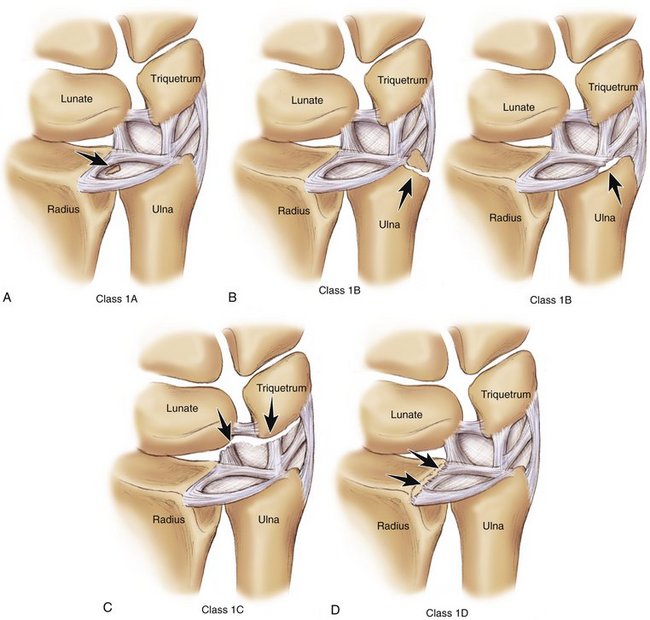
Ulnar-sided wrist pain, clicking, or weakness with rotation? We’ll confirm if it’s a central TFCC tear, calm it fast, and map your return to work, lifting, or climbing—with as little downtime as possible.
Booking: 👉 click here
Quick summary ⚡
- What it is: A tear in the central, avascular part of the triangular fibrocartilage complex (TFCC). 🧠
- How it feels: Pinkie-side wrist pain with rotation/tilting towards the pinkie side; clicking or catching is common. 🖐️
- Stability: Usually stable DRUJ (distal radioulnar joint); instability suggests a different tear (peripheral/foveal). 🧩
- Imaging: MRI is useful if symptoms persist or surgery is considered; arthroscopy is the gold standard if you’re heading to theatre. 🖼️
- Treatment: Settle pain + protect → restore motion → graded strength and function. Central tears don’t “heal” structurally, but symptoms often do. ✅
- Surgery: If needed, arthroscopic debridement trims the frayed edge; recovery is typically quicker than a repair. 🛠️
What is a central TFCC tear? 🧠
The TFCC is a cartilage-ligament complex that cushions the ulnar side of your wrist and stabilises the DRUJ. The central zone is thin and has very limited blood supply. That’s why a central tear doesn’t repair with stitches—instead, we manage load, reduce irritation, and, if needed, trim (debride) the frayed portion to stop mechanical catching.
Who gets it and why? 🤔
- Mechanisms: FOOSH (fall on an outstretched hand) with forearm rotation, repetitive ulnar-deviation loading (climbing, racquet, gym), heavy gripping or twisting at work.
- Wrist shape: A slightly ulna-positive wrist increases ulnar-side load and can irritate the central TFCC over time.
- Age/training load: Central thinning and fraying are more common with mileage, high repetition, or rapid load spikes.
Symptoms you’ll notice 🔎
- Deep ache or sharp pain on the pinkie-side of the wrist, worse with rotation (turning keys, opening jars) or ulnar deviation.
- Clicking/catching at certain angles; reduced grip due to pain.
- Often no sense of “giving way” (that’s more typical of peripheral/foveal tears).
Self-checks (not a diagnosis, but useful) 🧪
- Press test: Push up from a chair with hands flat—ulnar wrist pain suggests TFCC involvement.
- Ulnar fovea press: Tender between the ulnar styloid and pisiform = likely TFCC/ulnocarpal symptoms.
- Rotation provocation: Pain at end-range pronation/supination with a bit of axial load.
If everyday tasks are limited or pain persists >2–3 weeks, book an assessment. 🗓️
Do you need a scan? 🖼️
Not always. We diagnose centrally-driven TFCC pain clinically first.
- X-ray: Rules out fractures and assesses ulnar variance.
- MRI (3T preferred): Helpful if symptoms persist, if surgery is being considered, or to rule out peripheral/foveal tears, LT ligament injury, or ulnocarpal impaction changes.
- MR arthrogram: Occasionally used if we strongly suspect a small peripheral detachment that standard MRI might miss.
- Arthroscopy: Diagnostic and therapeutic if you proceed to debridement.
First-line treatment that actually works 🧰
Goal: Settle the irritable TFCC, then rebuild capacity so you can rotate, load, and live normally.
Unload & protect (2–6 weeks) 🛡️
- A forearm-based brace/splint to limit painful rotation/ulnar deviation.
- Modify lifts (neutral wrist), avoid long end-range rotations, swap painful tasks.
Calm symptoms 🌬️
- Short course of analgesia/NSAIDs if appropriate, ice/heat preference, and targeted taping for tasks.
- Consider a corticosteroid injection for stubborn flares (esp. with ulnocarpal irritation). It settles inflammation; it doesn’t “heal” the tear.
Restore motion, then strength 🔩
- Pain-free ROM first, then graded pronation/supination, isometric → isotonic grip, and ECU control (the ECU sheath blends with TFCC).
- Progress from unloaded → functional: jars/door handles → push/carry → sport-specific drills.
Progress back to life/sport 🎯
- Use a protective brace for early return to higher-risk tasks (climbing, racquet, manual work), then wean off.
Reality check: The central tear itself won’t “knit”; the frayed edge can desensitise with smart loading. Many people recover fully without surgery. ✅
When surgery makes sense and what it actually does 🛠️
If symptoms persist after a solid rehab block, or there’s mechanical catching from a flap, we discuss arthroscopic debridement.
- What happens: Through keyholes, the surgeon trims the unstable edge to a smooth, stable rim—no stitches, no grafts.
- Indications: Central tear with ongoing pain/clicking despite rehab; concomitant procedures if there’s ulnar impaction.
- Recovery: Usually faster than a repair—early motion once wounds settle, with progressive loading over weeks.
- Expectations: Pain relief and function usually improve; you’ll still need a graded re-loading plan.
If you also have ulnar-positive variance and persistent impaction pain, your surgeon may discuss an arthroscopic wafer (shaving a few millimetres off the distal ulna) or, in bigger cases, an ulnar-shortening osteotomy. These are not routine for isolated central tears but can matter if impaction is the driver.
Estimated rehab timelines ⏱️
Non-surgical pathway
- Weeks 0–2: Protect, settle pain, gentle mid-range ROM; brace for aggravating tasks.
- Weeks 2–6: ROM to end-range as tolerated; begin isometric → isotonic pronation/supination, grip, and ECU control; light carries.
- Weeks 6–12: Heavier grips, push/pull, forearm conditioning; sport/work re-intro with brace/tape as needed.
Return targets:
- Desk work: As tolerated (often immediate with modifications).
- Manual work/gyms: Staged by load; many comfortable by 6–10 weeks.
- Racquet/climbing: 8–12+ weeks, depending on moves and volume.
After arthroscopic debridement
- Days 3–10: Wounds settle; early ROM within comfort.
- Weeks 2–4: Light strength, task-based exposure; brace/tape for heavier tasks.
- Weeks 4–8: Build to pre-injury loads; sport-specific drills.
Return targets: Many resume light sport in 2–4 weeks; full loading follows tolerance and sport demands.
Sport-specific notes 🧗♂️🎾
Climbers
- Avoid prolonged ulnar-deviation + pronation under load early (gaston/undercling positions).
- Start with neutral-wrist movement, larger holds, lower angles; add ECU + forearm strength.
- Re-introduce crimping late; brace/tape for confidence early on.
Racquet sports
- Reduce heavy top-spin and late-contact rotation at first.
- Shorten sessions, add rest; tweak string pattern/tension if needed.
- Strength bias: pronation/supination endurance, forearm carries, grip variability.
Work hacks during manual tasks 🧤
- Use a neutral-wrist handle or adapter for repetitive tools.
- Switch twisting tasks between hands; micro-breaks every 15–20 minutes.
- Carry closer to the body; avoid one-handed long-lever loads early.
Red flags ⚠️
Don’t wait—get assessed if you have night pain that doesn’t settle, instability sensations, trauma with suspected fracture, or numbness/tingling into the hand.
FAQs ❓
Do central TFCC tears heal on their own?
Not structurally—the central zone has poor blood supply. But pain often settles with unloading and progressive rehab. ✅
Will a brace make me weaker?
Short-term protection won’t cause long-term weakness. Skipping graded loading might. We’ll dose the plan. 💪
How do I know if I need surgery?
If a well-run rehab block still leaves mechanical catching and activity-limiting pain, debridement is worth discussing. 🛠️
Is this the same as a peripheral/foveal tear?
No. Central = usually stable; peripheral/foveal can cause DRUJ instability and may need repair, not debridement. 🧩
What about injections?
They can calm inflammation and buy rehab time. They don’t “fix” the tear, but they can help you progress. 🌿
Ready to get on top of it? 🚀
Get a precise diagnosis and a step-by-step plan. 👉 click here to book online