
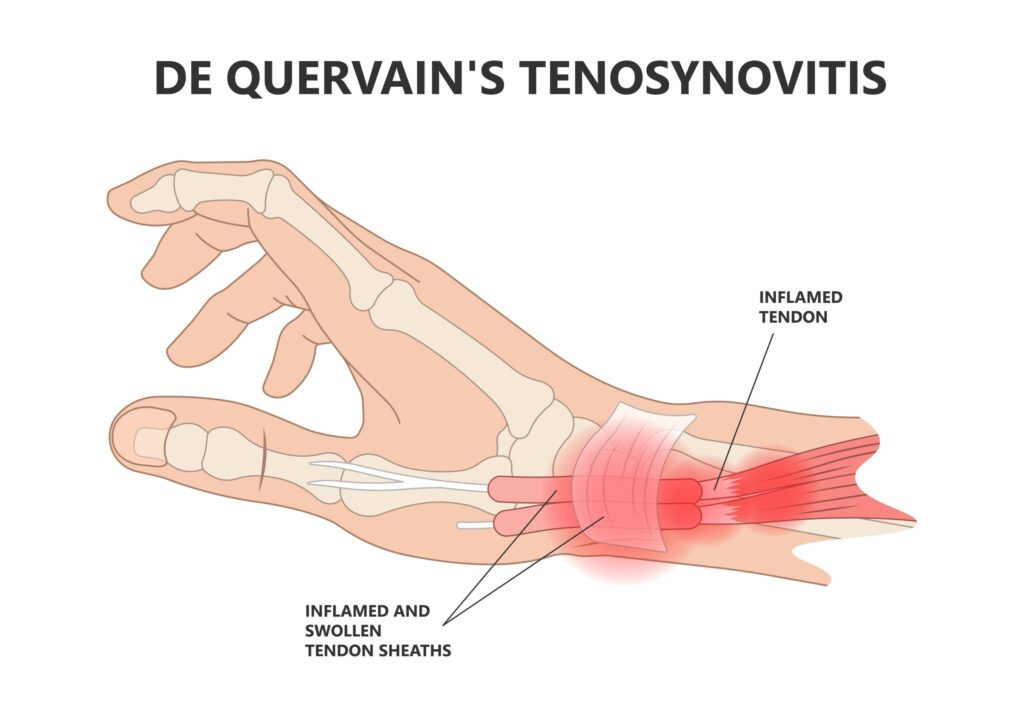
What Is De Quervain’s Tenosynovitis?
De Quervain’s Tenosynovitis is a painful condition caused by irritation or thickening of the tendons that run along the thumb side of your wrist—specifically, the abductor pollicis longus and extensor pollicis brevis. These tendons pass through a tight sheath near the radial styloid (bony bump at your wrist), and when inflamed, they can cause sharp, movement-related pain.
Real-Life Story: “I Thought I Slept Funny On It”
We recently saw a patient who’d been experiencing wrist pain for weeks. He assumed he’d just sprained it while lifting at work. After “resting it” for a month and wearing an off-the-shelf brace, nothing changed—except now his thumb and wrist were stiff and sore. Turns out, he had classic De Quervain’s—but never realised it, because he wasn’t a new mum.
Truth is, De Quervain’s affects more than just mums. We see it in climbers, manual workers, lab techs, and even office workers using a mouse all day. Some people are simply more anatomically predisposed, especially if they have a prominent radial styloid or a tendon variation.
Why It’s Often Misdiagnosed
Many people confuse De Quervain’s with:
- Wrist tendonitis
- Carpal tunnel syndrome
- Thumb arthritis
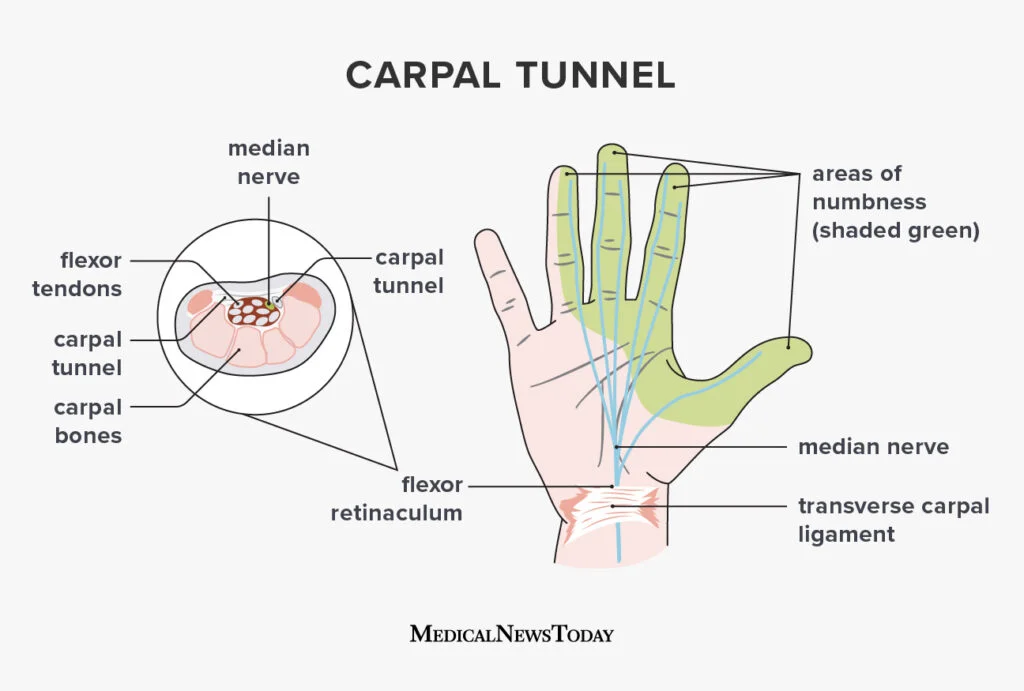
What makes De Quervain’s different?
- Pain is sharp and positional—not constant
- It’s worse when lifting, gripping, or twisting (e.g. wringing a towel, lifting a kettle)
- Finkelstein’s Test (thumb tucked into fist and wrist bent sideways) will reproduce the pain
What I’ve Noticed as a Physio
In clinic, I’ve found:
- De Quervain’s often follows a sudden lifestyle change—like becoming a new parent, starting a new manual job, or training harder at the gym.
- Rest alone doesn’t work. Most people try to “rest it,” but it’s difficult to avoid using your hand altogether. The result? No improvement after weeks of inactivity.
- Over-splinting can make it worse. Generic braces may restrict motion but don’t offload the right structures—often leading to joint stiffness and more pain once you return to activity.
- Some people hold their thumb extended or grip awkwardly without realising it, which contributes to irritation.
- Certain anatomical variations (like having 3 tendons in the compartment instead of 2) can overcrowd the space—these cases may not respond well to conservative treatment and may benefit from corticosteroid injections or surgery.
How Physiotherapy Can Help
Custom Splinting
We use thermoplastic splints tailored to your hand shape that are lightweight, breathable, and much more effective than off-the-shelf options. These splints provide targeted support and offloading of the irritated tendons, which helps settle pain in the early stages.
But here’s what many people miss:
Why Over-Splinting Can Backfire
Some patients try to manage De Quervain’s by wearing a generic splint for weeks or even months. While this often reduces symptoms while the splint is on, the pain tends to return—sometimes worse—once the splint is removed.
Without a clear plan to wean off the brace, the thumb and wrist, now stiff and deconditioned, are suddenly exposed to the same loads as before. That’s when patients experience the same sharp pain and mistakenly think the condition hasn’t improved at all.
Learning when—and how—to transition out of the splint is key.
At Crux Physio, we guide you through a structured process of unloading, then progressively reloading the thumb tendons safely to prevent setbacks.
Movement Retraining
We teach you to lift your baby, tools, or equipment using strategies that reduce tendon load.
For example, making a loose fist when lifting reduces strain. Avoid thumb abduction and wrist flexion, especially under load.
Exercise Therapy
- Tendon gliding exercises can provide almost immediate relief
- Gradual, pain-free loading helps restore strength without flaring symptoms
- We also correct gripping mechanics and address compensatory habits
Ergonomic Advice
- Office workers may benefit from an ergonomic mouse to avoid ulnar deviation
- We help climbers modify grip and training volume during recovery to avoid setbacks
Tailored Advice for Climbers, Parents & Workers
Climbers:
Avoid dynamic gripping moves that require ulnar deviation. Focus on open-handed holds. Gradually return to crimping only when pain-free.
Parents:
Lift your child using a neutral wrist and closed fist when possible. Avoid pinching under the armpits or pulling from behind the head.
Tradies/Lab Techs:
Modify tools to avoid repetitive pinching. Add padding or handles if needed. Prioritise thumb-neutral tasks where possible.
Most People Improve Within 2–3 Weeks
With early intervention and the right approach, De Quervain’s can improve significantly within a fortnight. For stubborn cases or those with anatomical variations, we’ll guide you on whether imaging, injections, or specialist input is needed.
Myth-Busting + FAQs
Myth: Only mums get De Quervain’s.
Fact: We see it in climbers, tradies, lab techs, and office workers too.
Can I still use my hand?
Yes. Complete rest isn’t helpful. Guided use and splinting are more effective.
Do I need surgery?
Not usually. Most cases respond well to physiotherapy. But if it lingers beyond 8–12 weeks with minimal improvement, we’ll discuss options.
Let’s Get That Wrist Sorted
If your wrist pain is stopping you from doing what you love—lifting, climbing, or caring for your child—we can help.
Same-day appointments and custom splints available.
Let’s get you back to using your hand with confidence.
👉 Book an appointment today and get expert support from a hand therapist who understands the importance of regaining function — fast.