
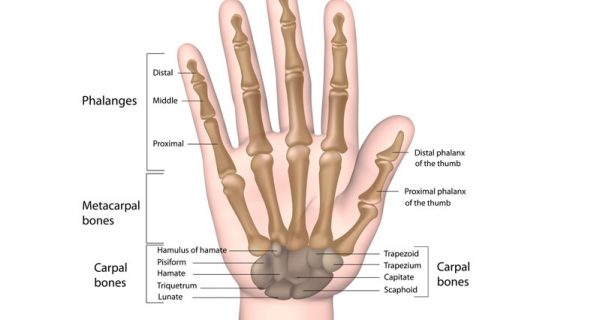
When people think of hand fractures, they often imagine a clean break that heals easily with a splint or rest. But the hand is a finely tuned instrument, and fractures in the metacarpals (the bones of the palm) and phalanges (the finger bones) can be surprisingly nuanced.
At Crux Physio & Hand Therapy, we help people navigate these injuries with care, clarity, and confidence—whether you’re a climber, tradesperson, new parent, or office worker.
🧩 Understanding the Types of Hand Fractures
Each fracture type has its own personality. Knowing what you’re dealing with is the first step toward the right recovery plan.
🔹 Metacarpal Fractures
Metacarpals are the long bones in your palm. Common patterns include:
- Neck fractures – especially the 5th metacarpal (aka Boxer’s fracture)
- Shaft fractures – which may angle or rotate if displaced
- Base fractures – near the wrist joint, sometimes involving joint surfaces
Fun fact: Certain angulations (like in the 4th or 5th metacarpals) can be safely left without surgery in some people, especially if there’s no rotation. But if the finger overlaps its neighbour when making a fist, it could affect grip function and may need more support.
🔹 Phalangeal Fractures
Phalanges are the bones of the fingers—each finger has three (proximal, middle, and distal), and the thumb has two. Common types include:
- Tuft fractures – at the tip, often from crush injuries
- Intra-articular fractures – involving the joint surface
- Avulsion fractures – such as mallet finger, where a tendon pulls a small piece of bone off
Here, it’s less about how broken the bone looks and more about whether the joint surface is involved, if there’s rotation, or if tendons are affected.
🧠 What Most People Don’t Know
Even seemingly small hand fractures benefit from thoughtful assessment. Here are a few things that don’t always get mentioned:
- ✋ Position matters – Splinting the hand in the right posture (commonly called the “safe position”) is key to preserving mobility. A poorly placed splint can make even a well-healed fracture feel stiff or weak.
- 🧠 Bones aren’t the whole story – Tendons, ligaments, and joint surfaces often play a role, even in “simple” fractures. That’s why a hand therapy perspective is so helpful—it goes beyond just the X-ray.
- ⏳ It’s not always about doing more – Sometimes less is more. Immobilising too long can cause stiffness, while starting movement too early can delay healing. The sweet spot depends on the fracture type.
- 🧪 You don’t always need surgery – Many fractures, even ones that appear dramatic, respond well to custom splinting and guided rehab when carefully managed.
🛠 When Surgery Might Be Considered
Most metacarpal and phalangeal fractures heal well without surgery, especially when promptly assessed and splinted in the right position. But in a small number of cases, surgery can help restore optimal alignment and function. These include:
| Scenario | Why It May Help |
|---|---|
| Displaced joint surface (intra-articular fracture) | To realign the joint and reduce risk of long-term stiffness |
| Rotational deformity | To prevent fingers from overlapping or crossing during a fist |
| Unstable fracture that won’t stay aligned in a splint | To maintain positioning during healing |
| Multiple fragments (comminution) | To reconstruct and support the shape of the hand |
| Failed conservative care (ongoing pain, poor function) | To realign and improve mechanics when healing hasn’t gone as planned |
This doesn’t mean all these situations must be operated on—it simply highlights when a surgical opinion might be helpful. At Crux, we work closely with your GP or surgeon if needed, and we always aim to give you the least invasive, most effective plan for your goals.
✅ Why Getting the Right Management Matters
Most hand fractures recover well with the right guidance. But because the hand is such a complex structure, it’s worth getting early input to avoid bumps in the road. Here’s what we focus on during your recovery:
| Focus | Why It’s Important |
|---|---|
| Finger alignment | Even small changes in rotation can affect grip and dexterity |
| Maintaining mobility | We aim to protect the fracture while keeping nearby joints moving |
| Tendon glide | Rehab helps restore smooth motion and reduce scar-related tightness |
| Joint congruency | Especially if the fracture is near a joint—we monitor closely to support healthy movement |
| Strength and confidence | We help you rebuild strength gradually so you can return to work, sport, or play feeling capable and confident |
The goal isn’t just bone healing—it’s restoring function and freedom in your hand.
🤝 How We Help at Crux Physio & Hand Therapy
We know every hand tells a different story. That’s why we offer:
- ✋ Custom thermoplastic splints that fit better, support healing, and protect movement
- 🧑⚕️ Detailed functional assessments, including grip, rotation, and tendon involvement
- 🧠 Clear education so you understand your injury and how to recover from it
- 💪 Tailored rehab plans to build strength, coordination, and resilience over time
Whether you’ve just injured your hand or are still struggling weeks after, we’re here to guide you back to full function—without shortcuts, guesswork, or unnecessary interventions.
📍 Let’s Get Your Hand Back in Action
You use your hand hundreds of times a day—don’t leave recovery to chance. A hand fracture may be small on X-ray, but with the right support, you can expect a strong, pain-free return to life.
🔧 Need help after a hand or finger injury?
Book an expert consult with Crux Physio & Hand Therapy in Croydon.
Let’s make sure it heals right the first time.