
🦴 What Is a Scaphoid Fracture?
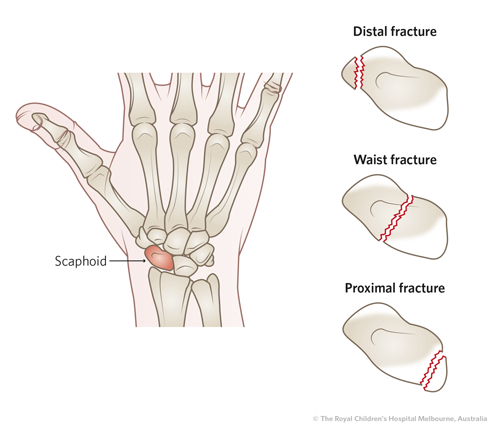
The scaphoid is a small, boat-shaped bone on the thumb side of your wrist, nestled among the complex architecture of the carpal bones. Because of its location and blood supply, fractures to this bone—especially from falls onto an outstretched hand (FOOSH)—can be subtle, slow to heal, or even missed if not investigated thoroughly.
This isn’t just any wrist fracture—its diagnosis, healing, and rehabilitation are quite different from more straightforward breaks.
🧭 Not All Scaphoid Fractures Are the Same: Why Location Matters
One thing that many don’t realise is that the exact location of the break within the scaphoid bone significantly influences management:
| Fracture Type | Location | Healing Potential | Management |
|---|---|---|---|
| Distal Pole | Closer to the thumb/wrist | Excellent blood supply – heals well | Often managed with splint or cast |
| Waist Fracture | Middle of the scaphoid | Moderate blood flow – slower healing | May need prolonged immobilisation or surgery |
| Proximal Pole | Closer to the forearm | Poor blood supply – risk of non-union | Often requires surgery and longer rehab |
👉 Nuance: The more proximal the fracture (closer to the forearm), the greater the risk for delayed healing or complications like avascular necrosis (bone death). That’s because blood enters the scaphoid from its distal end, flowing backwards—a detail often overlooked in general discussions.
🧪 “It Didn’t Even Swell Much”—Why Diagnosis Is Often Missed
Scaphoid fractures often don’t look dramatic. Unlike a broken forearm or wrist, you might still have:
- Minimal swelling
- Good finger and wrist movement
- Mild discomfort that you “shake off” or chalk up to a sprain
🔍 But if you press on the anatomical snuffbox (the hollow at the base of your thumb when it’s extended), and it’s sore—this is a red flag.
🩻 Even X-rays can miss the fracture in the early stages. That’s why repeat imaging or advanced scans (like MRI or CT) may be required, especially if pain persists.
🛠️ Management: Splint, Cast, or Surgery?
Treatment depends on location, displacement, and healing potential:
🧷 Non-Surgical
- Stable, non-displaced fractures (especially distal pole):
Treated with a thumb spica cast or custom thermoplastic splint for 6–12 weeks. - Close monitoring with repeat imaging is essential to ensure union.
🔩 Surgical
- Displaced fractures or those in the proximal pole often require internal fixation using a screw.
- Surgical management can sometimes accelerate return to activity (e.g., for athletes), but isn’t always necessary.
💡 A hand therapist plays a crucial role post-operatively or post-immobilisation to restore motion, strength, and coordination, especially in sports or hands-on professions.
🧠 Lesser-Known Facts Most People Miss
- The scaphoid doesn’t always show up on initial X-rays. Many people are sent home with a “sprain” only to return weeks later with persistent pain.
- Wrist stiffness isn’t just from the fracture. Long immobilisation leads to thumb and wrist stiffness, which needs tailored rehab—not just general wrist exercises.
- Proximal pole fractures can take 3–6 months to heal, even with surgery—patience is key.
- Returning to sport or manual work too early can re-fracture or stress the healing site. A hand therapist can help simulate sport- or work-specific activities before you’re back on the field or tools.
⚠️ What Happens If a Scaphoid Fracture Doesn’t Heal Properly?
These outcomes are uncommon if the fracture is managed early and appropriately, but here’s what can happen when healing is delayed or incomplete—and how they’re usually managed:
| Complication | What It Means | What Can Be Done About It |
|---|---|---|
| Non-union | The two ends of the bone don’t fully join back together | May need surgery to secure the bone and encourage healing, often using a bone graft |
| Avascular necrosis (AVN) | Poor blood flow causes part of the bone to weaken or collapse | Often treated with surgical fixation and close monitoring; therapy supports function during recovery |
| Wrist arthritis | The wrist joint becomes stiff or painful over time, especially with load | A structured rehab program can help maintain movement and strength; surgery is considered in advanced cases |
🤹 Scaphoid Fractures in Real Life: A Case Snapshot
A 29-year-old carpenter tripped and landed on his hand. X-ray was “inconclusive,” but his snuffbox was tender. MRI confirmed a non-displaced waist fracture. He wore a custom splint for 8 weeks and followed a graded return-to-load plan with his hand therapist.
At week 10, he was back using power tools—confidently and safely—without surgery.
👉 Lesson: Imaging + load management + early rehab = better outcomes.
🧤 How Can a Hand Therapist Help?
A hand therapist offers more than just exercises:
- Custom splinting that’s far more comfortable than a generic brace
- Ongoing assessment of healing progress and wrist mobility
- Return-to-sport or work simulations for safe reintegration
- Manual therapy to reduce stiffness
- Education on activity pacing and flare-up prevention
This specialised approach helps prevent complications while speeding up recovery in a controlled and measured way.

✅ Ready to Get Back to Doing What You Love?
If you have had a fall, wrist pain that’s lingering, or a scaphoid fracture that’s just not progressing—now’s the time to act.
At Crux Physio & Hand Therapy, we offer:
- 📆 Same-day assessment for wrist and hand injuries
- 🖐️ Custom splinting solutions on-site
- 🧠 Expert rehab from clinicians who understand hands, climbing, trades, and performance
👉 Book your consult today and get personalised support to recover fully and safely.