
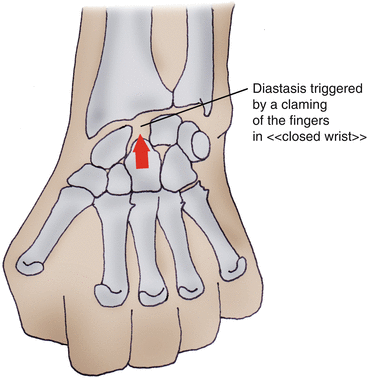
If you’ve had wrist pain since a fall, or your wrist just doesn’t feel right when pushing, lifting, or using tools, there’s a chance you’ve injured a key stabilising structure in your wrist — the scapholunate ligament.
It’s an injury that’s often missed, but if left untreated, it can lead to long-term issues like weakness, clunking, and even early arthritis.
🧱 What Is the Scapholunate Ligament?
Your wrist is made up of many small bones. Two of these — the scaphoid and lunate — are held together by the scapholunate ligament.
This ligament acts like a keystone in an arch, quietly holding things together. You don’t notice it when it’s working, but if it tears or becomes unstable, your wrist may feel weak, painful, or unreliable — especially during pushing or weight-bearing tasks.
🤕 How Does This Injury Happen?
The most common cause is a fall onto an outstretched hand, especially when the wrist is bent backwards and angled slightly toward the pinky side. This position puts a lot of stress on the ligament and can cause it to stretch or tear.
But you don’t always need a fall to injure it.
⚠️ Other Causes of Scapholunate Ligament Injury
There are three main ways this ligament can be injured:
| Cause | How it Happens | Common in… |
|---|---|---|
| Traumatic | A sudden force through the wrist (e.g. fall on an outstretched hand, drill kickback) | Tradies, athletes, climbers |
| Degenerative | Wear and tear over time due to repetitive use or ageing | Manual workers, middle-aged adults |
| Inflammatory | Ongoing joint inflammation (like in rheumatoid arthritis) weakens the ligament over time | People with RA, lupus, or autoimmune arthritis |
🛠️ Examples of Each:
- Trauma: Tripping and landing on your hand, or using a power drill that suddenly jerks back — a known “wrist breaker” injury.
- Degeneration: Years of using your wrist heavily — lifting, twisting, gripping — slowly breaks down the ligament without you even realising.
- Inflammation: Conditions like rheumatoid arthritis cause the joint lining to become inflamed, which eats away at nearby ligaments over time.
In all three cases, the end result can be the same: wrist pain, instability, and loss of function.
🧩 Signs and Symptoms to Look Out For
- Pain in the middle or thumb-side of the wrist
- Discomfort when pushing (e.g. getting off the floor, doing push-ups)
- Clicking or clunking during movement
- Weak grip or wrist fatigue
- A feeling that your wrist “gives out” or isn’t trustworthy
🖼️ Why It’s Often Missed
Scapholunate injuries don’t always show up on a normal wrist X-ray. Early or partial tears may look fine — even though the ligament is damaged.
That’s why special tests may be needed:
- Clenched fist X-rays (taken while making a fist)
- MRI or MR arthrogram to look at soft tissue
- Wrist arthroscopy (camera inside the joint) to confirm the diagnosis
🧰 What Can You Do About It?
✅ Milder or Early-Stage Injuries
With partial tears or early changes, many people can avoid surgery and recover with:
- Wrist support (splint or tape)
- Reducing painful activities
- Specific exercises to restore wrist stability and control
- Close monitoring over time
🕒 Recovery takes time — often 3 to 6 months — but many return to full function with guided rehab.
⚠️ More Severe or Long-Standing Injuries
If the ligament is fully torn or the bones are no longer aligned, you may:
- Need referral to a hand specialist
- Consider imaging to rule out instability or early arthritis
- In some cases, surgery is considered (especially if instability affects daily function)
🔥 Inflammatory Causes: What’s Different?
If the cause is inflammation (like rheumatoid arthritis), treatment may also include:
- Referral to a rheumatologist for disease-modifying medications
- Wrist protection during flare-ups
- Modified rehab that accounts for joint sensitivity
- In some cases, early ligament or joint preservation surgery if instability worsens
🧠 Important: Inflammatory joint conditions can cause ligament damage silently — so if you have RA and your wrist feels unstable, don’t ignore it.
🧠 Recovery Tips from a Hand Physio
- 🔒 Don’t rush back to load — build control first
- 🖐️ Train your wrist in neutral before adding push or grip movements
- ⚖️ Use wobble boards, laser pointers, or bodyweight shifts to retrain coordination
- 🧗 Climbers: Avoid palm presses and mantles early on. Use neutral hangs if needed.
- 🛠️ Tradies: Be cautious with drills and power tools. Use both hands where possible and keep your wrist neutral.
🚩 When to Get It Checked
- Pain that’s not improving after 4–6 weeks
- Clicking, catching, or a clunking sensation
- Weakness, loss of grip, or a sense of instability
- You’ve had a fall or power tool injury
- You have rheumatoid arthritis and your wrist feels “off”
👋 We Can Help
At Crux Physio & Hand Therapy, we’re experts in managing hand and wrist injuries — especially those that are often missed or misunderstood.
Whether your injury came from a fall, your tools, or a chronic condition, we’ll give you:
- A clear diagnosis
- Personalised rehab
- Hands-on care and advice to rebuild confidence in your wrist again
👉 Book your appointment today at our Croydon clinic and take the first step toward feeling better.