
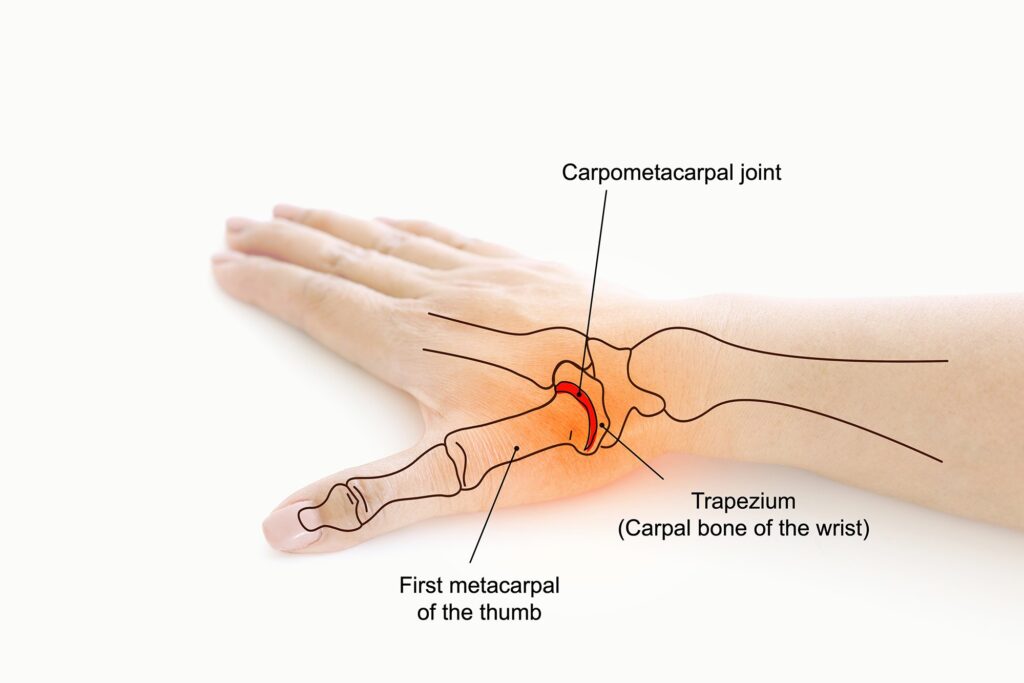
Arthritis is often associated with visible joint changes or older age—but thumb osteoarthritis (OA) doesn’t always follow that script. It often starts quietly, with discomfort during simple tasks like opening jars, holding a pen, or using your phone.
At Crux Physio & Hand Therapy, we see it in climbers, hairdressers, office workers, and tradies—not just retirees. And one thing’s clear: movement, not rest, is part of the solution.
What Is Thumb Osteoarthritis, Really? 🔍
Thumb OA most commonly affects the carpometacarpal (CMC) joint, located at the base of your thumb. This joint allows you to perform complex movements—like pinching, gripping, or rotating your thumb in a circular motion.
When OA develops, the cartilage within the joint becomes irritated, and the surrounding ligaments and stabilisers can weaken, making the joint more sensitive to certain loads. But contrary to popular belief, this isn’t about overuse or “wearing out” the joint. It’s about how the joint responds—and adapts—to forces over time.
What Most People Don’t Realise About Thumb OA 🤯
✅ It’s not caused by overuse alone
Repetitive tasks aren’t inherently bad—what matters is how well your thumb is supported and controlled. Inadequate muscle support, poor joint mechanics, or unaddressed past injuries can sensitise the joint over time.
✅ Hypermobility is a key factor
People with joint hypermobility often lack the ligamentous restraint that keeps the CMC joint stable. Without muscular control, this can contribute to OA symptoms—even in young adults.
✅ Pain doesn’t always match imaging
Many people with X-ray-confirmed OA have no pain. And some with significant pain have minimal imaging changes. That’s because symptoms relate more to joint load sensitivity and muscle function than to cartilage status alone.
✅ It’s often misdiagnosed
Early OA symptoms can mimic De Quervain’s tenosynovitis or trigger thumb. A thorough clinical assessment is critical to avoid the wrong splint—or worse, prolonged rest without a clear plan.
Common Signs & Symptoms of Thumb OA 🛑
- Pain at the base of the thumb, especially during grip or pinch
- Weakness or difficulty holding objects (e.g., jars, pens, keys)
- Clicking, grinding, or a sense of instability
- Tenderness or mild swelling over the CMC joint
- Progressive stiffness or loss of thumb motion
Case Example:
A 42-year-old florist came in with aching thumb pain that worsened with bouquet wrapping and pruning. She had used a generic chemist splint for weeks—without improvement. Once we addressed her joint stability, muscle imbalances, and reintroduced controlled loading, her pain significantly reduced and her grip returned.
So… Is Movement Good or Bad for OA? 🏋️♀️
Movement is medicine.
The old idea that using your joint causes it to “wear out” is outdated. In reality:
- Cartilage needs movement to stay healthy through nutrient exchange.
- Muscles protect joints by absorbing load and enhancing stability.
- Avoiding movement leads to stiffness, weakness, and more pain over time.
We now know that joint pain in OA relates more to how the joint tolerates load—not how much you use it. When we progressively improve your joint’s ability to handle load, you feel better, not worse.
Evidence-Informed Treatment That Actually Works 🛠️
| Treatment Option | What It Does | Ideal When… |
|---|---|---|
| Custom Splinting | Supports the joint and calms irritation | During flare-ups or repetitive tasks |
| Thumb-Specific Strengthening | Activates key stabilisers (e.g. APL, 1st DI, opponens pollicis) | For grip endurance and dynamic control |
| Neuromuscular Re-training | Builds awareness and control during functional tasks | For hypermobility or poor motor patterning |
| Joint Mobilisation | Improves joint glide and comfort | When stiffness or positional bias is present |
| Taping or Bracing | Provides short-term support or feedback | For sport, climbing, or physically demanding work |
| Graded Exposure to Load | Rebuilds tolerance through controlled, progressive loading | Core principle of modern rehab |
| Injection (Cortisone) | Temporarily reduces inflammation | May be useful for severe flare-ups |
| Surgery (e.g. CMC Arthroplasty) | Last resort for persistent instability or collapse | Only if conservative rehab fails |
What Makes Our Approach Different at Crux 🧠✨
We don’t treat you like a worn-out part—we treat you like a person with a dynamic joint system that can adapt, strengthen, and improve.
Our rehab plan is tailored to:
- Restore stability through muscle control
- Support the joint in key tasks
- Improve your confidence using the thumb
- Guide you through safe reloading—not just rest
For climbers, hairdressers, office workers, and tradies alike, we make rehab practical and meaningful.
Frequently Asked Questions 🤔
Q: Will my thumb joint ever go back to “normal”?
Maybe not structurally—but with targeted rehab, most people regain function, strength, and confidence. Pain doesn’t always mean damage.
Q: Is it safe to keep using my hand?
Yes. In fact, avoiding use can make things worse. The key is to reintroduce movement in a graded, supported way that builds capacity.
Q: Do I need surgery?
In most cases, no. Rehab is effective for the vast majority of people when properly targeted. Surgery is only for persistent cases that haven’t improved with structured care.
Don’t Let Thumb Pain Hold You Back 🙌
If you’re struggling to grip, pinch, or work without discomfort, don’t accept it as “just arthritis.” The right treatment can make all the difference—and it starts with understanding how your joint works, not fearing it.
🟡 Book Your Thumb Assessment Today
Our hand therapy team at Crux Physio & Hand Therapy in Croydon specialises in thumb and upper limb injuries. Whether it’s early OA, hypermobility, or post-injury pain—we’ll guide you through a recovery plan that’s science-backed and practical.
📍 Crux Physio & Hand Therapy Helping hands move better, feel stronger, and recover with confidence.