
Waking up with a finger stuck in a bent position? Feeling it click painfully when trying to straighten it? You’re not alone—and chances are, it’s not just “getting old” or “arthritis.” At Crux Physio & Hand Therapy, we regularly see people who have lived with this for weeks or even months, unsure what’s going on or when to seek help.
The good news? Trigger finger is very treatable, especially when caught early.
What Is Trigger Finger?
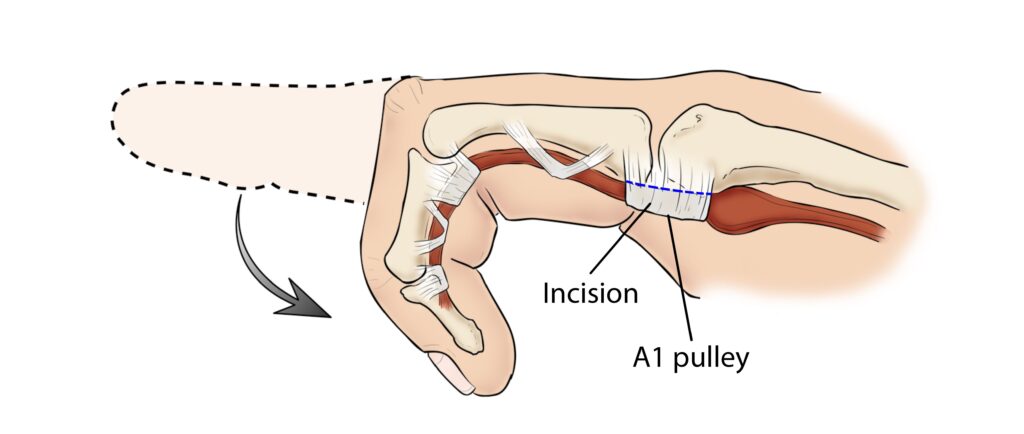
Trigger finger, medically known as stenosing tenosynovitis, happens when the flexor tendon of a finger or thumb struggles to glide smoothly through a tight pulley at the base of the digit (most often the A1 pulley). Over time, the tendon may become irritated and thickened, or develop a nodule. The result? Your finger catches or locks—like a rope snagging in a pulley.
It’s more common than most people realise—and often misdiagnosed.
Why Does It Happen?
Trigger finger tends to develop in people who:
- Use their hands repetitively for work (e.g. hairdressers, tradies, musicians)
- Perform frequent gripping (climbers, baristas, DIYers)
- Live with systemic conditions like diabetes or rheumatoid arthritis
- Experience scar tissue formation after injury or hand surgery
Sometimes it develops gradually—other times, it feels like it appeared overnight.
🧭 The Quinnell Classification: Understanding Severity
Trigger finger severity is graded clinically using the Quinnell Classification, which helps determine the best course of action:
| Grade | Description |
|---|---|
| Grade 0 | Normal—no pain, locking, or clicking |
| Grade 1 | Uneven movement or tenderness, but no locking |
| Grade 2 | Finger catches but can be straightened actively |
| Grade 3 | Finger locks and must be straightened with help |
| Grade 4 | Finger is stuck in a bent position; cannot extend |
At Grades 1–2, conservative care is often effective. By Grade 3, you may need medical input, and Grade 4 cases are usually referred for surgical opinion—especially if long-standing.
Common Symptoms
You may be dealing with trigger finger if you notice:
- Clicking or snapping when bending/straightening the finger
- Pain or tenderness at the base of the affected digit
- Stiffness in the morning or after rest
- A small, tender nodule in the palm
- In later stages: finger locking in flexion, needing help to straighten
Real-Life Insight from Our Clinic
We often hear:
“I thought it would just go away if I rested it.”
“The clicking didn’t bother me until the day it got stuck.”
One common pattern we see: people self-manage with off-the-shelf splints for months, thinking immobilisation alone will solve the issue. The splint reduces pain—until they suddenly stop using it. Now the finger is stiff, weak, and the pain is back in full force. It’s not just about rest—it’s about timing, load, and gradual reactivation.
How We Help at Crux Physio & Hand Therapy
We take a staged, evidence-informed approach to treating trigger finger:
- Custom-made splints to offload the A1 pulley (especially night splints)
- Tendon gliding exercises to maintain movement
- Load modification strategies to reduce strain during daily tasks
- Soft tissue release & swelling management
- Education on when and how to wean off splints
If your case is advanced or unresponsive, we’ll coordinate with your GP for possible cortisone injection referral or hand surgeon opinion.
Trigger Finger in Different People
🧗 Climbers: Constant crimping and friction over the A1 pulley puts tendons under repeated stress. While trigger finger is less common than pulley injuries or flexor tendon strains in climbers, we occasionally see cases where repetitive gripping contributes to A1 pulley irritation.
🔨 Manual Workers & Tool Users: Repetitive gripping, use of vibrating tools, and forceful hand use are major contributors—especially in jobs that require sustained flexion or load through the palm and fingers.
💉 People with Diabetes:
Trigger finger is significantly more common in people with diabetes—affecting up to 10–20% compared to 2–3% in the general population.
Underlying factors include:
- Glycosylation of tendon collagen leading to stiffness
- Thickening of the tendon sheath and pulley
- Reduced tendon gliding and impaired healing
These patients often present with multiple digits involved and a slower response to conservative care, making early intervention essential.
Case Example
“Jane,” a 42-year-old hairdresser, came in with clicking in her ring finger for 3 months. She’d tried splinting herself and taking anti-inflammatories. On assessment, she was at Grade 2. With custom night splinting, tendon glides, and slight changes to how she held her scissors, her symptoms resolved in under 6 weeks—without needing injections.
What If It Doesn’t Improve?
If hand therapy and splinting don’t resolve the symptoms, your options include:
- Cortisone injection: effective in 50–70% of early-stage cases
- Surgical release: a short procedure where the A1 pulley is released to restore tendon glide (typically used for Grades 3–4 or unresponsive cases)
We’ll help guide you toward the least invasive, most effective pathway for your situation.
What You Can Do at Home
- Avoid forcefully bending or stretching a painful finger
- Try padded tools or spring-loaded scissors for repetitive tasks
- Use a basic finger splint at night to reduce friction
- Don’t wait for it to get stuck—early help leads to faster recovery
FAQs
Is trigger finger the same as arthritis?
No. While arthritis can coexist, trigger finger is a tendon issue, not a joint problem.
Can it go away on its own?
Mild cases may resolve—but persistent clicking or locking often worsens without targeted rehab.
Will I need surgery?
Most cases don’t. With early physiotherapy and load management, surgery can often be avoided.
Not sure if you’re dealing with trigger finger or something else?
If your finger is catching, clicking, or stuck—early treatment matters. At Crux Physio, we offer same-day or next-day hand therapy appointments in Croydon to help you get answers and relief quickly.
👉 Book an appointment today and get expert support from a hand therapist who understands the importance of regaining function — fast.